Bottled Water vs. Tap Water: Is Your Family Spending Over $1,000 a Year on Drinking Water?
by J&J on October 28, 2026
You grab a case of bottled water at the grocery store.
Then another one next week.
And another the week after that.
Before you know it, you're rearranging the pantry, hauling heavy cases out of the car, and collecting empty plastic bottles from around the house.
Sound familiar?
For a lot of busy Northeast Ohio families, bottled water has become just another item on the grocery list.
But here's something worth thinking about.
What if the water you're buying every week is costing your family more than you realize?
And what if there were a way to get great-tasting, filtered drinking water straight from your own kitchen?
At J&J Plumbing, Heating, Cooling & Electric, we're helping homeowners explore exactly that.
💧 GET YOUR FREE WATER QUALITY TEST →
The Bottled Water Cost That Might Surprise You
Let's do some quick math.
A 40-pack of store-brand bottled water has recently been listed online for approximately $5.47.
That sounds pretty affordable, right?
But watch what happens when you start buying it every week.
| Bottled water purchased | Approximate yearly cost |
|---|---|
| 1 case per week | $284 |
| 2 cases per week | $569 |
| 3 cases per week | $853 |
| 4 cases per week | $1,138 |
These examples use a 40-bottle case priced at $5.47, purchased every week for 52 weeks. Actual prices, consumption, and costs will vary.
A family buying four cases a week could spend $1,138 in a single year.
That's 8,320 individual plastic bottles.
And over five years, assuming the same buying habits and prices?
$5,688 spent on bottled water.
Think about what that money could mean for your family.
A vacation. Home improvements. Extra savings. Or simply a little more breathing room in the grocery budget.
Of course, not every family drinks that much bottled water. But even two cases a week add up to hundreds of dollars annually.
And that's before considering all those trips to the store and the effort of carrying cases home.
So Why Do So Many Families Choose Bottled Water Instead of Tap Water?
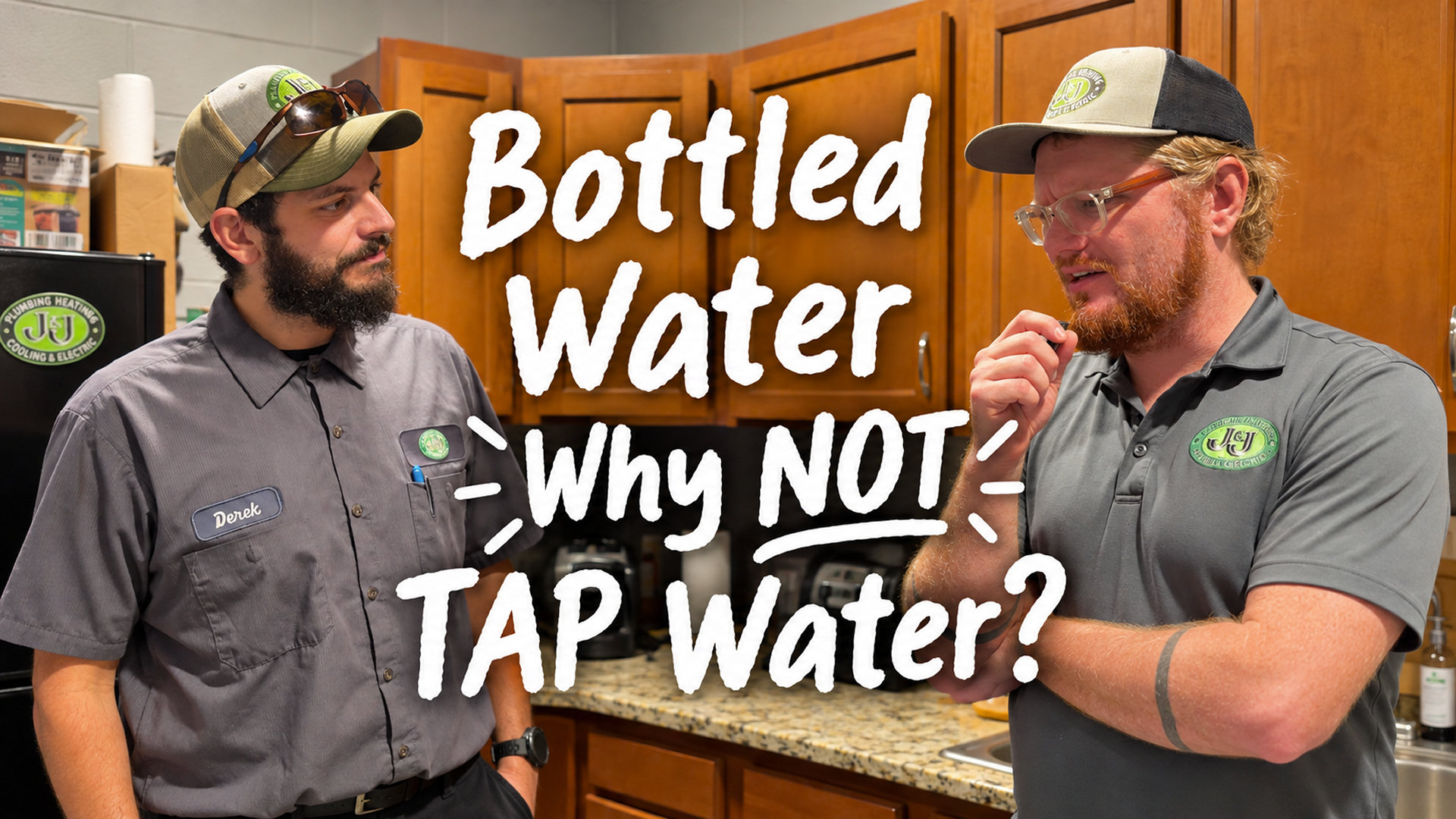
We asked Derek from the J&J plumbing team a simple question:
"If we're spending all this money on bottled water, why don't we just drink the water from our faucet?"
For many homeowners, the answer comes down to taste, smell, and personal preference.
Maybe your tap water has a chlorine-like taste.
Maybe you've noticed mineral buildup around your faucets.
Or maybe you've simply grown accustomed to the taste and convenience of bottled water.
But here's the important part.
Municipal tap water isn't automatically bad water.
In fact, public drinking water is regulated to meet federal and state safety requirements.
That doesn't mean every family will love its taste, though.
And it doesn't mean you can't improve certain characteristics of the water coming into your home.
Let's look at a few common reasons homeowners explore drinking water treatment.
1. Chlorine: Why Does My Tap Water Taste Different?
Many public water systems add chlorine or chloramine to help disinfect drinking water.
These disinfectants serve a critical purpose: protecting the water supply from harmful microorganisms.
According to the CDC, the low levels permitted in regulated drinking water are considered safe.
However, they can affect how your water tastes and smells.
For some families, that's enough to make them reach for bottled water.
A properly selected carbon filtration system can help reduce chlorine taste and odor. Many drinking water treatment systems incorporate carbon filtration as part of their design.
The goal isn't to make safe municipal water sound dangerous. It's to help you enjoy the water you're already paying for.
2. Hard Water: Could Minerals Be Affecting Your Home?
Have you ever noticed white buildup around a faucet?
Or spots on your drinking glasses after they've been washed?
Those may be signs of hard water.
Hard water contains naturally occurring minerals, primarily calcium and magnesium.
Those minerals aren't automatically unsafe to drink, but they can contribute to scale buildup around your home.
A traditional water softener primarily addresses hardness throughout the house.
A drinking water reverse osmosis system, on the other hand, is designed to reduce dissolved substances in the water delivered to a particular faucet.
And that's an important distinction.
You may not need to treat every gallon of water in your home just to improve your drinking water.
3. What About Fluoride in Tap Water?
Some municipal water systems add fluoride to drinking water to help prevent tooth decay.
Fluoride may also be naturally present in water.
For families who are interested in reducing fluoride, certain reverse osmosis systems are certified to do so.
However, fluoride at recommended levels has established dental-health benefits, so removing it isn't automatically necessary or beneficial for everyone.
The key is knowing what you're trying to accomplish and choosing a system with verified performance for those specific goals.
What Exactly Is Reverse Osmosis Drinking Water?
Reverse osmosis, commonly called RO, is a water treatment process that pushes water through a specialized membrane.
The membrane reduces many dissolved substances in the water, while other components may address taste, odor, and additional treatment goals.
A residential drinking water RO system is often installed beneath the kitchen sink.
That means you can have a dedicated source of filtered drinking water right where your family needs it most.
Imagine:
- Filling reusable water bottles before school without opening another plastic bottle.
- Making coffee with filtered water from your own kitchen.
- Having drinking water available without storing bulky cases.
- Making fewer bottled-water purchases.
- Knowing which contaminants your particular system is certified to reduce.
That's the convenience that makes reverse osmosis worth considering.
It's important to remember that RO systems vary. One system may have certifications for reductions that another doesn't.
Look for independently certified equipment, such as systems evaluated under NSF/ANSI 58, with the specific contaminant-reduction claims that matter to your household.
Is Reverse Osmosis Water Better Than Bottled Water?
Here's where the conversation gets interesting.
Some bottled water is purified using reverse osmosis or other treatment processes.
That's right. A treatment process used to produce certain bottled waters can also be installed in your home.
So instead of continually purchasing and carrying bottles, your family may be able to enjoy similarly treated drinking water directly from the kitchen sink.
But let's be clear.
An RO system isn't automatically safer or higher-quality than every brand of bottled water.
Water quality depends on the original water supply, the treatment process, the system's certifications, and how the equipment is maintained.
Both bottled water and properly regulated tap water can be safe choices.
The advantages of home RO often come down to convenience, reducing disposable bottles, personal taste preferences, and potential long-term costs.
Could an RO System Actually Save Your Family Money?
Potentially, especially if your household buys bottled water frequently.
But the calculation isn't quite as simple as comparing the price of bottled water with the price of tap water.
A home reverse osmosis system has its own costs, including:
- Equipment and professional installation
- Replacement filters and membranes
- Routine maintenance
- Water used by the filtration process
Traditional reverse osmosis systems can also send a significant amount of water to the drain as part of their operation, although more efficient models are available.
That's why choosing an appropriately sized, water-efficient system is important.
When you're comparing options, consider the total cost over several years - not just the initial purchase price.
If your family is already spending hundreds of dollars each year on bottled water, it's worth finding out whether a home filtration system makes financial sense.
Do You Need to Treat Your Whole Home or Just Your Drinking Water?
This is one of the most common questions we hear.
And the answer depends on your family's needs.
If your biggest concern is the taste of your drinking water, a dedicated kitchen filtration system may be sufficient.
If you're dealing with scale buildup throughout the house, a whole-home water softener may be worth considering.
If you're concerned about several water-quality issues, a combination of systems might make sense.
And if you're happy with your current tap water and it meets your needs?
You may not need additional treatment at all.
At J&J, we believe water treatment should fit your home and your priorities.
Not every family needs the same system.
Northeast Ohio Homes Have Different Water Needs
Whether you're in Akron, Canton, Stow, Hudson, Cuyahoga Falls, Tallmadge, Green, or another Northeast Ohio community, your water characteristics can vary.
Different public utilities use different source waters and treatment methods.
Some homes rely on private wells.
Even plumbing materials within a house can influence certain water-quality characteristics.
That's why what works for your neighbor may not be right for you.
A water test can help you begin understanding your water's pH, chlorine, iron, and hardness characteristics.
For specific concerns such as lead, bacteria, or PFAS, separate certified laboratory testing may be necessary. A basic in-home screening does not automatically test for every potential contaminant.
Before You Buy Another Case of Bottled Water, Ask Yourself One Question
What would life look like if you didn't have to keep buying it?
No more loading cases into your grocery cart every week.
No more finding room for them in the pantry.
Fewer empty bottles piling up around your house.
Just convenient, filtered water available whenever your family needs a drink.
For some households, that's a meaningful improvement.
And it all begins with understanding the water you already have.
J&J Plumbing, Heating, Cooling & Electric can help you explore water treatment options, including professionally installed drinking water reverse osmosis systems.
You don't have to choose a system before talking with us.
Start with the water. Then decide what makes sense.
💧 WA-TER You Waiting For?
Your family deserves clear answers about the water you drink every day.
And if you're spending hundreds of dollars a year on bottled water, now might be the perfect time to explore another option.
Schedule your FREE Water Quality Test and water treatment estimate with J&J today.
SCHEDULE MY FREE WATER QUALITY TEST →
J&J Plumbing, Heating, Cooling & Electric
Your Neighbors. Serving You.
Frequently Asked Questions
Is bottled water safer than tap water?
Not necessarily. Municipal tap water and commercially bottled water are subject to different regulatory requirements, and both can be safe drinking-water choices. Actual quality depends on the source and treatment.
How much can a family spend on bottled water each year?
At an example price of $5.47 per 40-pack, buying two cases per week costs approximately $569 a year. Buying four cases per week costs approximately $1,138. Prices and household consumption vary.
Can reverse osmosis reduce chlorine and fluoride?
A complete RO system may include carbon filters that reduce chlorine taste and odor. Certain RO systems are also certified to reduce fluoride. Check the exact system's certified claims rather than assuming all systems provide identical reductions.
Is reverse osmosis the same as a water softener?
No. A traditional water softener reduces hardness minerals throughout a home's water supply. A point-of-use RO system treats drinking water at a particular fixture.
Does reverse osmosis eliminate the need for bottled water?
For many households, it can significantly reduce bottled-water purchases. Portable bottled water may still be convenient for travel, emergencies, and outdoor activities.
Will J&J help me decide whether reverse osmosis is right for my home?
Yes. Schedule a free water quality test and discuss your household's water characteristics, treatment goals, and available options.
GET YOUR FREE WATER QUALITY TEST →

We've had your back since 1989. For time-sensitive requests, please give us a call at 330-678-1400.