Does Your Whole House Need Water Treatment, or Just Your Drinking Water?
by J&J on October 23, 2026
You fill your kids' water bottles before school. You make coffee, wash the dishes, take showers, and run another load of laundry.
Water is part of practically everything your family does.
But here's a question most of us don't think to ask:
Do you actually know what's in the water you're using every day?
Maybe you've noticed white buildup around your faucets. Maybe your shower leaves your skin feeling dry. Or maybe your family goes through case after case of bottled water because nobody really likes the taste of what's coming out of the kitchen faucet.
If any of that sounds familiar, you're not alone.
And here's the good news: You might not need to treat every drop of water in your home to make a meaningful difference.
At J&J Plumbing, Heating, Cooling & Electric, we believe the best place to start isn't with an expensive system. It's with understanding your water.
Schedule Your FREE Water Quality Test →
First, Did You Know There Are Two Ways to Think About Your Home's Water?
One of the easiest ways to understand water treatment is to divide your water into two categories.
1. Drinking Water: What Goes Into Your Family's Bodies
This includes the water your family drinks, uses to make coffee, fills reusable bottles with, and cooks with.
For some families, drinking water is their biggest concern.
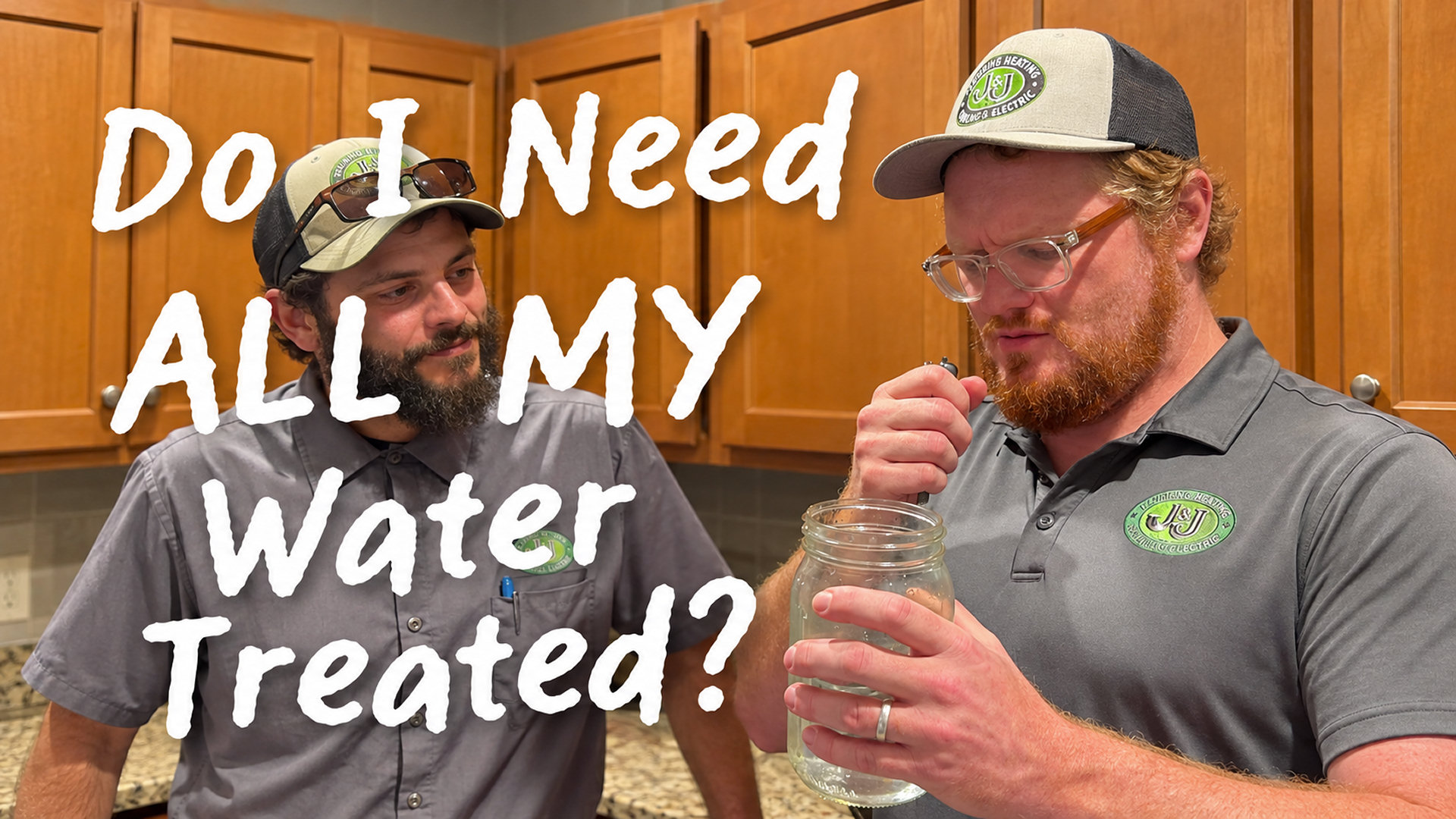
Maybe you're tired of buying bottled water every week. Maybe your tap water has an unpleasant taste or smell. Or maybe you simply want to understand your options for water filtration.
The good news? You may only need to treat the water coming from your kitchen sink.
A reverse osmosis (RO) drinking water system can reduce a wide range of dissolved substances, depending on the system and its certifications.
It's an option worth exploring if your primary goal is better-tasting drinking water and less dependence on disposable water bottles.
2. Working Water: What Your Family Uses Around the House
Now think about all the water your family doesn't drink.
It's running through your showerheads, washing your towels, cleaning your dishes, and flowing through your water heater.
And if that water contains higher levels of hardness minerals, it can affect much more than you might realize.
Have you ever noticed:
- White, chalky buildup around bathroom faucets?
- Spots left behind on freshly washed dishes?
- Soap that doesn't lather the way you expect?
- Mineral deposits around your showerhead?
- Scale building up inside water-using appliances?
Those can all be signs of hard water.
Hard water contains dissolved minerals, primarily calcium and magnesium. They're naturally occurring and don't automatically mean your water is unsafe to drink.
But over time, those minerals can leave deposits inside plumbing fixtures, water heaters, and appliances.
Sometimes the issue isn't what's in your drinking glass. It's what your water is leaving behind throughout your home.
That's where a whole-home water softener may make sense.
What About Chlorine in Your Tap Water?
Here's something that surprises a lot of homeowners.
Many public water systems use chlorine or chloramine to disinfect drinking water. These disinfectants serve an important purpose: helping protect the water supply from harmful microorganisms.
In fact, properly regulated disinfectant levels are considered safe.
But you might still notice an unpleasant chlorine taste or odor.
If you've ever filled a glass from your kitchen faucet and thought, "That just doesn't taste very good," you know exactly what we're talking about.
Certain carbon filtration systems are designed to reduce chlorine taste and odor.
And depending on your family's needs, that filtration might make sense at one faucet or throughout the home.
The important thing is choosing a treatment system based on what you actually want to improve.
You shouldn't have to guess.
Is Northeast Ohio Known for Hard Water?
Water quality can vary from one community to the next - and sometimes between neighboring homes.
Across Akron, Canton, Cleveland, Stow, Cuyahoga Falls, Tallmadge, and surrounding Northeast Ohio communities, homes may receive water from different public supplies or private wells.
The source of your water, its mineral content, and even your home's plumbing can affect what reaches your faucets.
For example, Ohio EPA guidance explains that water hardness is associated with naturally occurring calcium and magnesium and may contribute to scale buildup in water heaters.
That's why your neighbor's water treatment needs might be completely different from yours.
Your home deserves a recommendation based on your water, not someone else's.
So, Does Your Family Need a Water Softener, a Drinking Water Filter, or Both?
Here's the simplest way to think about it.
If your biggest concern is drinking water: An under-sink reverse osmosis system or another appropriately certified drinking water filter may be worth considering.
If your biggest concern is mineral buildup, spotted dishes, or scale: A whole-home water softener may be the better starting point.
If your concern is chlorine taste or odor: A properly selected carbon filtration system may help.
If you're experiencing several of these issues: A combination of systems might be appropriate.
And if your water quality is already meeting your family's needs?
You might not need additional treatment at all.
That's something we believe homeowners deserve to hear.
What Can a FREE Water Quality Test Tell You?
Before investing in water treatment, it helps to understand what's happening in your home.
J&J offers a FREE Water Quality Test to help you begin that conversation.
Depending on what's included in the test, our team can evaluate common water-quality characteristics and discuss concerns such as hardness, taste, odor, and your family's treatment goals.
It's important to know that a basic in-home water test isn't the same as a comprehensive laboratory analysis. Testing for specific contaminants such as lead, bacteria, or PFAS may require separate certified testing.
Our goal is to help you understand your options and make an informed decision.
Because there isn't one perfect water treatment system for every house.
There's the right solution for your home, your priorities, and your family.
Your Family Uses This Water Every Single Day. Isn't It Worth Knowing More?
You don't need another complicated household decision.
You don't need someone telling you that you must buy the most expensive system.
And you certainly don't need to keep wondering whether there's a better way to handle the water your family uses every day.
You deserve simple answers, knowledgeable people, and a solution that makes sense.
At J&J Plumbing, Heating, Cooling & Electric, our plumbing team helps Northeast Ohio homeowners understand their water treatment options and choose systems that fit their needs.
The first step is FREE.
💧 WA-TER You Waiting For?
Your family uses water every single day. Let's help you understand it.
Schedule your FREE Water Quality Test today.
BOOK MY FREE WATER QUALITY TEST →
J&J Plumbing, Heating, Cooling & Electric
Your Neighbors. Serving You.
Frequently Asked Questions About Water Treatment
Is hard water unsafe to drink?
Generally, water hardness alone isn't considered a health hazard. However, it can cause mineral buildup, reduce soap effectiveness, and affect certain appliances.
Will a water softener make my drinking water taste better?
A softener primarily removes hardness minerals. If taste and odor are your main concerns, a drinking water filtration system may be a better fit.
Can reverse osmosis replace buying bottled water?
For many families, an appropriately selected reverse osmosis system can provide convenient filtered drinking water at home, reducing the need to purchase bottled water. Actual savings depend on household usage and system costs.
Does every Northeast Ohio home need a water softener?
No. Your water hardness, the issues you're experiencing, and your personal preferences should determine whether a softener makes sense.
How do I know which water treatment system is right for my home?
Start by understanding your water supply, identifying your biggest concerns, and getting appropriate testing. J&J's FREE Water Quality Test is a simple first step.
Find Out More About Your Water - Schedule Your FREE Test

We've had your back since 1989. For time-sensitive requests, please give us a call at 330-678-1400.