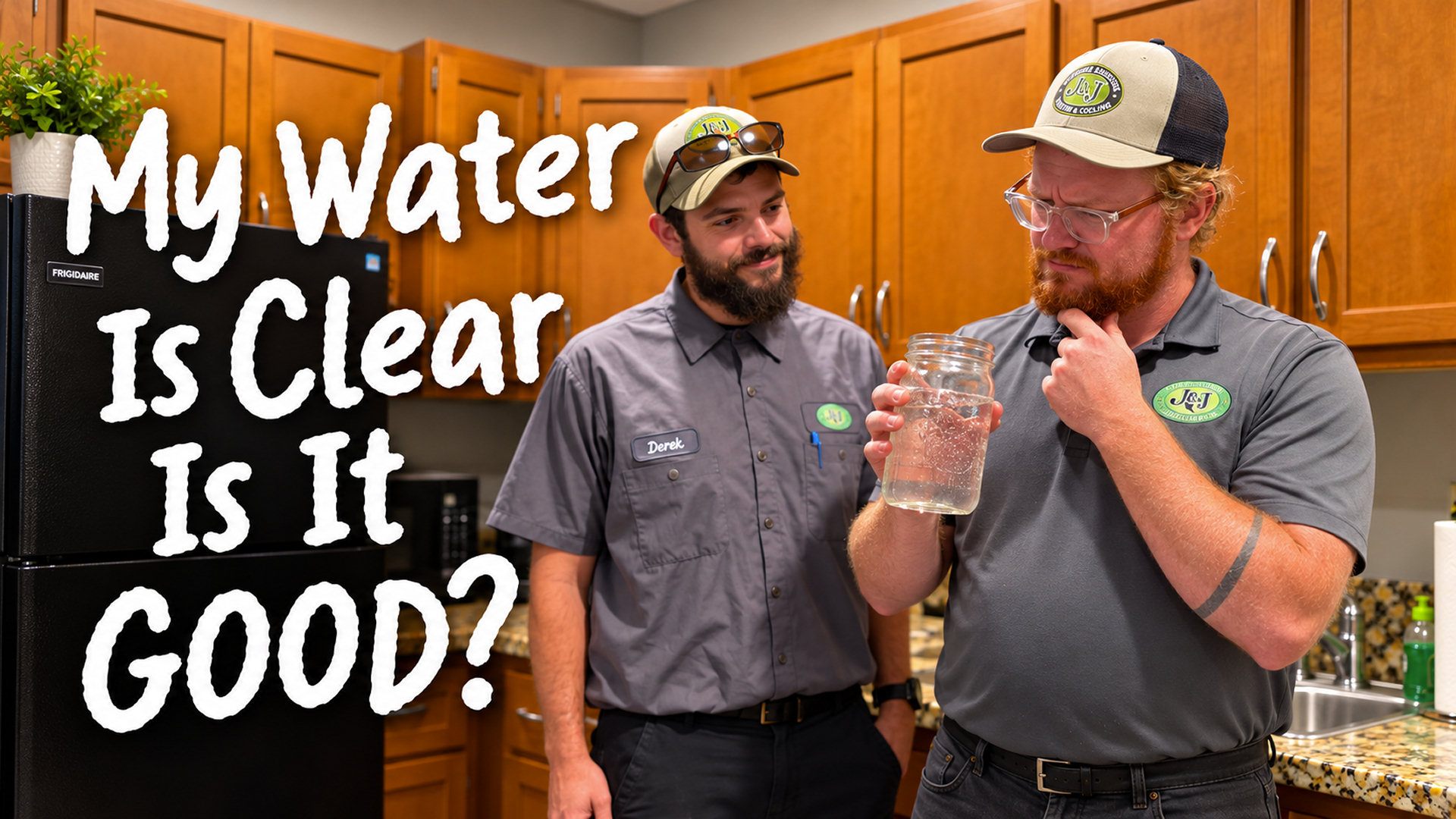
My Water Looks Clear. Is It Really Good?
by J&J on October 26, 2026
You turn on the kitchen faucet, fill a glass, and take a drink.
The water looks perfectly clear. It doesn't have a strange color, and nothing seems out of the ordinary.
So naturally, you assume it's good water.
But here's something that might surprise you: Just because water looks clean doesn't tell you everything about what's in it.
And when it's the water your family drinks, cooks with, bathes in, and uses every day, it's worth understanding a little more.
At J&J Plumbing, Heating, Cooling & Electric, we believe homeowners deserve straightforward answers about their water without pressure to purchase something they might not need.
That's why we're offering a FREE Water Quality Test to help you get started.
Schedule Your FREE Water Quality Test →
1. Yes, There May Be Chlorine in Your Drinking Water. Here's Why.
Did you know many Northeast Ohio public water systems use disinfectants such as chlorine or chloramine?
It's true.
According to the Centers for Disease Control and Prevention (CDC), water utilities add these disinfectants to help kill harmful germs and keep drinking water safe as it travels through pipes to your home.
Chlorine actually serves an important purpose.
The CDC says chlorine levels up to 4 parts per million are considered safe in drinking water.
So why would anyone want to filter it?
Because even when water meets safety standards, its taste and smell may not be what your family prefers.
Why Does My Tap Water Sometimes Smell Like a Swimming Pool?
Have you ever filled a glass of tap water and noticed a chlorine-like smell?
Or maybe your kids prefer bottled water because they don't like how the water tastes at home.
You're not imagining things.
The CDC confirms that disinfectants such as chlorine can affect the taste and odor of drinking water.
That doesn't automatically mean there's something unsafe about it. But it does mean there may be an opportunity to improve the drinking water experience for your family.
The solution?
Depending on your water supply and goals, a properly selected activated carbon filtration system may help reduce chlorine taste and odor.
And if your primary concern is drinking water, you might not need an expensive whole-home system.
A filter installed at your kitchen sink could be enough to address the problem.
2. Why Does My Skin Feel Dry After a Shower?
Let's talk about something a lot of Northeast Ohio families experience.
You step out of the shower, dry off, and reach for the lotion.
Your skin feels tight. Maybe your hair doesn't feel quite as soft as you'd like.
Could your water be contributing?
Possibly.
Skin dryness can have several causes, including hot showers, harsh soaps, seasonal changes, and existing skin sensitivities.
Some people also report irritation or discomfort associated with their water.
But it's important to understand that ordinary levels of chlorine in regulated municipal drinking water aren't automatically harmful to your skin.
If you're experiencing dryness, the answer isn't necessarily removing chlorine.
Instead, it's worth looking at the bigger picture, including whether your home has hard water.
What Exactly Is Hard Water?
Hard water contains dissolved minerals, primarily calcium and magnesium.
These minerals occur naturally as water moves through the environment.
And here's the interesting part:
Hard water can be completely clear.
You won't necessarily recognize it by looking into a glass.
You may, however, notice its effects around your house.
Some common signs include:
- White mineral deposits around faucets and showerheads
- Cloudy spots on glasses and dishes
- Soap scum in bathtubs and showers
- Reduced soap lather
- Scale buildup inside water-using appliances
According to the U.S. Geological Survey, hard water can contribute to mineral deposits inside pipes and equipment.
Over time, those deposits can become a frustrating household maintenance problem.
3. Could Your Water Be Affecting Your Appliances?
Think about everything in your house that uses water.
Your dishwasher. Your washing machine. Your shower fixtures. Your water heater.
Now imagine mineral deposits gradually building up in that equipment.
That's one reason water hardness matters.
Over time, scale can reduce the efficiency of certain water-heating equipment and interfere with normal water flow.
Your appliances represent a significant investment in your home.
Understanding your water hardness is one way to make more informed decisions about protecting that investment.
And no, a water softener isn't automatically necessary for every home.
But if your water is particularly hard, it's worth discussing the potential benefits.
4. Not Every Home Needs the Same Water Treatment System
Here's where things get interesting.
Let's say you live in Stow, Ohio, and you're concerned about the taste of your drinking water.
Your friend in Cuyahoga Falls may be dealing with scale buildup around her faucets.
And your family member outside Canton might rely on a private well.
Those are three different situations.
They may require three completely different approaches.
If You Want Better-Tasting Drinking Water
A drinking water filtration system may be worth considering.
Depending on the contaminants you want to reduce, options include appropriately certified carbon filters and reverse osmosis (RO) systems.
A reverse osmosis system can reduce a range of dissolved substances, depending on its design and certifications.
For households that regularly purchase bottled water, a properly selected drinking water system may also reduce ongoing bottled-water purchases.
If You're Dealing With Hard Water
A water softener may help reduce the minerals responsible for scale and soap scum.
Whole-home softening is different from drinking water filtration because it addresses hardness throughout the house.
If You're Concerned About Chlorine Taste or Odor
A carbon filtration system may be helpful.
Some systems treat water at one faucet. Others are designed for whole-home applications.
It's important to choose a system certified for your particular treatment goals. A product designed to reduce chlorine taste isn't necessarily certified to remove other contaminants.
The best system isn't the biggest or most expensive one. It's the one that addresses your actual water-quality needs.
5. What About Water Quality in Akron, Canton, Cleveland, and Surrounding Communities?
Northeast Ohio is home to many different public water systems and private wells.
That means water characteristics can vary depending on where you live and which supply serves your property.
Even within the same community, differences in plumbing materials and household equipment may influence what reaches your faucets.
And here's an important detail:
Clear water isn't proof that every potential contaminant is absent.
For example, the Environmental Protection Agency (EPA) warns that certain contaminants, including dissolved lead, cannot be identified by appearance alone.
That doesn't mean your water contains lead. It simply illustrates why appearance isn't a reliable substitute for appropriate testing.
Your public water utility's annual Consumer Confidence Report is a useful starting point for understanding your municipal water supply.
If you use a private well, regular testing is especially important because private wells aren't regulated under the same federal drinking water requirements as public systems.
6. What Happens During a FREE Water Quality Test?
This is where J&J can help.
Instead of guessing which water treatment equipment your home might need, start by learning about your water.
During a water-quality consultation, our team can discuss the issues you've noticed and explain the testing and treatment options available for your home.
Maybe your main concern is water hardness.
Maybe you don't like the taste or smell of your tap water.
Or perhaps you're spending money on bottled water every week and wondering whether there's a more convenient alternative.
Our goal is to help you understand the options.
One important distinction: Basic in-home water-quality screening is not a substitute for comprehensive laboratory testing. Specific concerns involving lead, bacteria, PFAS, or other contaminants may require separate certified testing.
The right testing depends on what you're trying to find out.
7. Your Family Deserves Answers, Not Guesswork
Think about how often you use water.
Every morning when you fill your coffee maker.
Every afternoon when your kids reach for a drink.
Every evening when you're washing dishes, doing laundry, or getting everyone ready for bed.
It's something your family depends on constantly.
And yet most of us rarely stop to think about it.
Your water might already be meeting your needs.
Or there may be practical ways to improve its taste, reduce mineral buildup, or make life a little more convenient.
Either way, wouldn't you rather know?
At J&J Plumbing, Heating, Cooling & Electric, we help Northeast Ohio homeowners make informed decisions about their plumbing and water treatment needs.
Our licensed plumbing team can explain appropriate treatment options and professionally install systems when needed.
And it all starts with one simple step.
💧 WA-TER You Waiting For?
Your water looks clear. Now find out more about it.
Schedule your FREE Water Quality Test with J&J Plumbing, Heating, Cooling & Electric.
SCHEDULE MY FREE WATER QUALITY TEST →
Frequently Asked Questions
Is chlorine in tap water dangerous?
Chlorine is commonly used to disinfect drinking water. According to the CDC, regulated levels up to 4 parts per million are considered safe. Some homeowners choose filtration to improve taste and odor.
Can chlorine affect the taste of my drinking water?
Yes. The CDC confirms that chlorine and chloramine can change the taste and smell of tap water.
Can hard water look completely clear?
Absolutely. Hardness comes from dissolved minerals such as calcium and magnesium. Water can appear perfectly clear while containing substantial hardness.
Will a water softener remove chlorine?
A conventional water softener is designed primarily to reduce hardness minerals, not chlorine. Chlorine reduction generally requires an appropriate filtration system.
Do I need to filter my entire home's water?
Not necessarily. If your biggest concern is drinking water taste, a point-of-use system may be sufficient. If you're dealing with hardness throughout the house, a whole-home solution may be worth considering.
How can I find out more about my home's water quality?
Start by reviewing your public water utility's water-quality report and identifying your concerns. Appropriate water testing can help guide the next steps.
Get Started With a FREE Water Quality Test From J&J →

We've had your back since 1989. For time-sensitive requests, please give us a call at 330-678-1400.