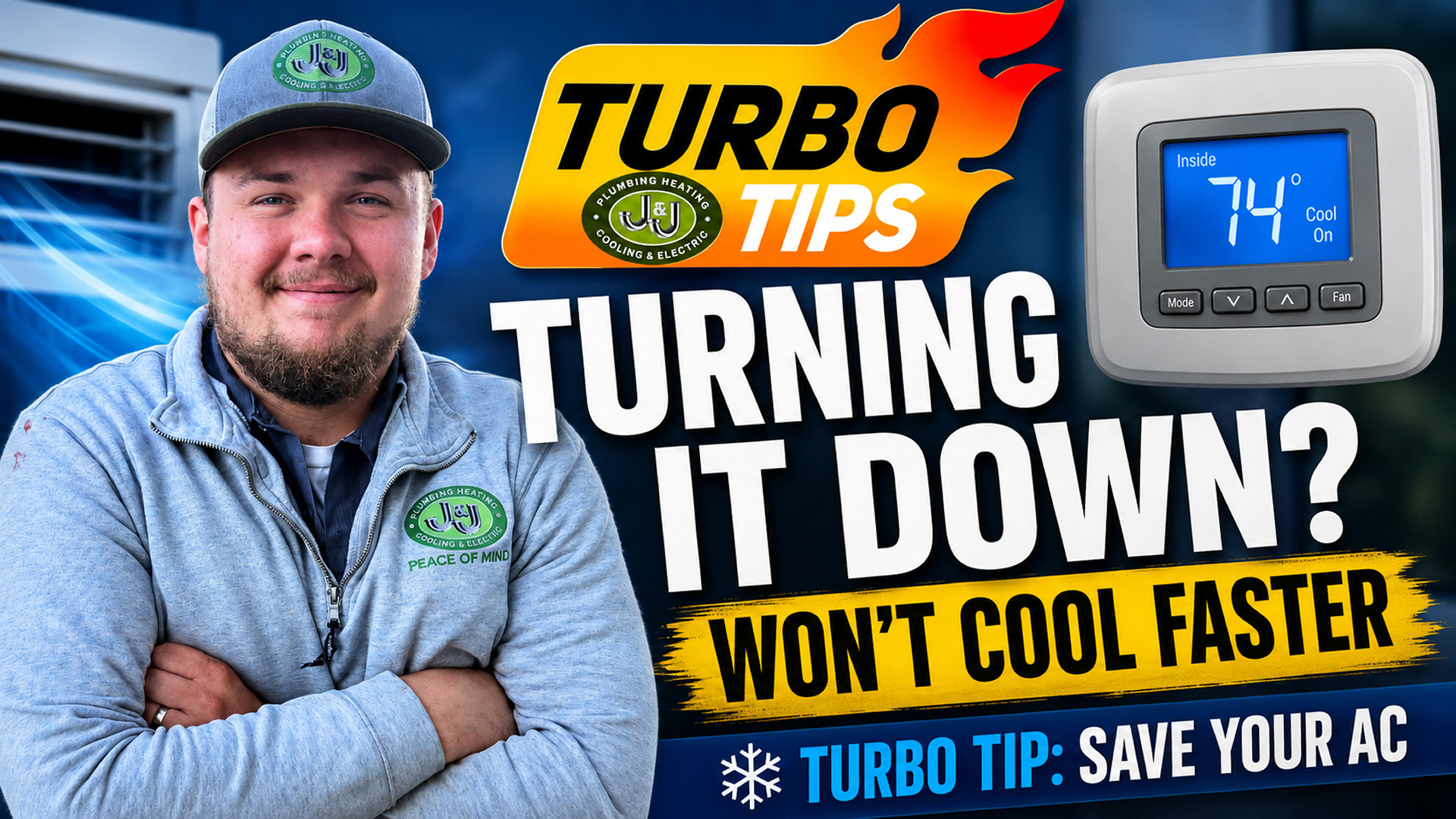
Turbo Tips: Does Turning the Thermostat Down Cool Your Home Faster?
by J&J on August 7, 2026
The house is 78 degrees, so you set the thermostat to 62. That should make the air conditioner work harder and cool the house faster - right?
Not usually.
For most residential air-conditioning systems, the thermostat works more like a temperature target than an accelerator. Lowering the setting far below the temperature you actually want generally won't make the air coming from your vents colder or make your home cool faster. It simply tells the system to continue operating longer.
That means you could end up with longer run times, unnecessary energy use and added wear on your cooling system without getting comfortable any faster.
Here's what Northeast Ohio homeowners should know about thermostat settings, extreme summer temperatures and the signs that an air conditioner may need professional attention.
Why Lowering the Thermostat Doesn't Cool Your Home Faster
Your thermostat monitors the temperature inside your home. When the indoor temperature rises above your selected setting, the thermostat signals the air-conditioning system to begin cooling.
The AC then removes heat from the indoor air and transfers that heat outside. Once the thermostat detects that your home has reached the selected temperature, it tells the system to stop or reduce its cooling output.
On a traditional single-stage air conditioner, the equipment generally operates at its designed cooling capacity whenever it is running. Setting the thermostat to 62 instead of 72 does not suddenly unlock a more powerful cooling mode.
It only changes how long the thermostat asks the equipment to continue running.
Think of it like an elevator button. Pressing the button ten times doesn't make the elevator arrive faster. In the same way, dramatically lowering the thermostat doesn't usually speed up the cooling process.
More advanced two-stage and variable-speed systems can adjust their output, but even with these systems, setting an unnecessarily low temperature does not provide instant cooling.
Can Setting the Thermostat Too Low Hurt Your AC?
Occasionally setting the thermostat lower than intended will not automatically destroy your air conditioner. However, repeatedly asking the system to reach an unrealistic temperature can create unnecessarily long run times.
During extreme heat, that may mean your system operates for hours without reaching the selected setting. Longer operation can increase electricity use and place additional demand on components that may already be struggling.
Trane notes that lowering the thermostat farther than necessary can result in higher energy costs because the system continues cooling beyond the temperature you actually need.
The U.S. Department of Energy also explains that a smaller difference between indoor and outdoor temperatures generally results in a lower cooling bill. Its recommendation is to keep the thermostat as high as comfortably possible during the summer.
The goal isn't to make your home uncomfortable. It's to choose a realistic setting and allow the system to cool steadily instead of constantly changing the thermostat.
What Is the Air-Conditioner “20-Degree Rule”?
You may have heard that an air conditioner can only cool a house approximately 20 degrees below the outdoor temperature.
That idea can be a useful general expectation during unusually hot weather, but it should not be treated as an absolute rule or a complete test of your system's condition.
For example, if it is 95 degrees outside, a home that remains near 75 degrees may indicate that the system is removing a significant amount of heat. However, this does not mean that every properly operating system must maintain exactly a 20-degree indoor-to-outdoor difference.
Several factors affect how well a home maintains temperature:
- The size and condition of the air conditioner
- Indoor and outdoor humidity
- Attic and wall insulation
- Air leaks around doors and windows
- Ductwork condition
- Direct sunlight and window exposure
- The number of people and appliances producing heat
- How often exterior doors are opened
- Air-filter and coil cleanliness
- The home's overall construction
A properly sized system is selected according to the cooling needs of the home - not a single outdoor-temperature formula. An undersized system may run continuously and struggle to reach the thermostat setting, while an oversized system can cool too quickly without adequately controlling humidity.
So, while the 20-degree idea can help set expectations on a very hot day, it should not be used by itself to decide whether your AC is working correctly.
How Long Should an Air Conditioner Run on a Hot Day?
It is normal for an air conditioner to run longer during the hottest part of summer.
A system's job is not only to lower the air temperature. It must continuously remove heat entering through the roof, windows, walls, doors and air leaks. Humidity also affects how comfortable the home feels and how hard the equipment must work.
On a hot, humid Northeast Ohio afternoon, a properly operating AC may run for an extended period. Long operation alone does not necessarily mean something is broken.
What matters is whether the system is:
- Producing noticeably cool air
- Gradually lowering or maintaining the indoor temperature
- Providing reasonable airflow from the vents
- Controlling indoor humidity
- Operating without unusual noises, odors or ice buildup
If the system runs continuously while the indoor temperature keeps rising, that is different. It may indicate that the equipment can no longer keep up or that a problem is reducing its cooling capacity.
Jay's Pro Tip: When your HVAC unit breaks down at the most inconvenient moment, you can trust our emergency air conditioning repair service for timely solutions.
Why Is My AC Running but Not Cooling the House?
An air conditioner does not need to shut down completely to have a problem.
The fan may still run, the outdoor unit may still make noise and air may continue coming through the vents - even when the system is not cooling properly.
Common reasons an AC runs without adequately cooling include:
1. An Incorrect Thermostat Setting
Make sure the thermostat is set to Cool, not Heat or Fan.
The fan setting should normally be on Auto. When the fan is set to On, the blower may continue circulating room-temperature air after the outdoor cooling equipment shuts off. This can make it seem like the AC is blowing warm air.
2. A Dirty Air Filter
A clogged filter restricts airflow through the system. Reduced airflow can make it harder to cool the home and may contribute to the indoor coil freezing.
ENERGY STAR recommends inspecting, cleaning or changing central HVAC filters regularly. It warns that a dirty filter can increase energy costs and potentially contribute to early equipment failure.
3. A Blocked Outdoor Unit
Grass clippings, weeds, leaves and other debris can collect around the outdoor condenser.
The outdoor unit must release the heat removed from your home. Restricted airflow around the condenser coil can reduce the system's ability to transfer that heat outdoors.
Keep vegetation and loose debris away from the unit, but avoid taking the cabinet apart or bending the delicate coil fins.
4. A Frozen Evaporator Coil
Ice on the indoor coil or refrigerant line can severely limit cooling.
Frozen coils may be caused by restricted airflow, a dirty filter, blower problems or low refrigerant. Continuing to operate a frozen system can make the problem worse.
Turn the cooling system off and contact a qualified HVAC professional if you see ice.
5. A Refrigerant Leak
Air conditioners do not normally “use up” refrigerant like a vehicle uses gasoline.
If a system is low on refrigerant, there may be a leak. Low refrigerant can cause weak cooling, long run times, frozen coils and potential compressor damage.
Refrigerant problems require professional diagnosis and handling.
6. Dirty Coils
Dirt on the indoor evaporator coil or outdoor condenser coil interferes with heat transfer.
Even when the system continues operating, dirty coils can reduce efficiency and make it more difficult to maintain the thermostat setting.
7. Leaking or Damaged Ductwork
If conditioned air escapes into an attic, basement, crawlspace or wall cavity, less cooled air reaches the rooms where you need it.
Duct leakage can contribute to hot and cold spots, weak airflow and longer cooling cycles. ENERGY STAR identifies duct systems as a common source of wasted heating and cooling energy.
8. An Improperly Sized System
An air conditioner that is too small may struggle during hot weather and run almost constantly.
A unit that is too large can also create comfort problems by cycling off before it has removed enough indoor humidity. Proper sizing should be based on the home's construction, insulation, windows, air leakage and other cooling-load factors - not square footage alone.
9. Aging or Failing Components
Weak capacitors, failing motors, damaged electrical components and compressor problems can reduce cooling performance before the system stops operating entirely.
That is why it is important not to ignore gradual changes in airflow, sound, run time or comfort.
What Temperature Should You Set Your Thermostat in Summer?
There is no single perfect temperature for every family or home.
ENERGY STAR commonly suggests setting the thermostat as high as comfortably possible and references approximately 78 degrees as an energy-conscious starting point. However, your ideal setting may be different based on humidity, health needs, sleep preferences and who is in the home.
A practical approach is to:
- Set the thermostat to a temperature that feels comfortable.
- Leave it there long enough for the system to respond.
- Adjust it one or two degrees at a time.
- Use ceiling fans to improve comfort in occupied rooms.
- Use a programmable or smart thermostat to reduce unnecessary operation while you are away.
Ceiling fans cool people, not rooms, so turn them off when nobody is using the room.
The most important Turbo Tip is simple:
Set the thermostat to the temperature you actually want. Setting it dramatically lower will not usually get you there faster.
Simple Ways to Help Your AC Keep Up
Before assuming that your air conditioner needs repair, take a few basic steps:
- Confirm the thermostat is set to Cool.
- Set the thermostat fan to Auto.
- Check the air filter and replace it if it is dirty.
- Make sure supply vents and return-air grilles are open and unobstructed.
- Close exterior doors and windows.
- Close curtains or blinds on windows receiving direct sunlight.
- Move lamps and heat-producing electronics away from the thermostat.
- Remove loose debris and vegetation from around the outdoor unit.
- Avoid using the oven during the hottest part of the day.
- Use ceiling fans in occupied rooms.
Heat-producing appliances near a thermostat can cause the system to run longer because the thermostat senses the additional heat. Window coverings, air sealing and proper insulation can also reduce the amount of heat entering the home.
When Should You Call an HVAC Professional?
Contact an HVAC technician when:
- The indoor temperature continues rising while the AC runs
- The vents are blowing warm or room-temperature air
- Airflow has become noticeably weak
- The system repeatedly starts and stops
- Ice appears on the refrigerant lines or indoor equipment
- The outdoor unit is not operating
- The circuit breaker repeatedly trips
- You notice unusual noises or burning odors
- Certain rooms are suddenly much warmer than others
- Your energy bill rises without an obvious explanation
- The system no longer reaches temperatures it maintained in the past
Carrier advises turning off an air conditioner that is operating but not cooling properly because continued operation may place additional strain on the compressor or worsen certain problems.
Don't Keep Lowering the Thermostat - Find the Real Problem
If your home will not cool down, the answer probably isn't hiding at the bottom of your thermostat's temperature range.
Your system may simply be dealing with an unusually hot day. But it could also have restricted airflow, dirty coils, a refrigerant problem, damaged ductwork or a failing component.
J&J Plumbing, Heating, Cooling & Electric provides air-conditioning repair, maintenance, installation and emergency cooling services throughout Akron and Northeast Ohio. J&J services major air-conditioning brands and serves communities across Summit, Cuyahoga and Lorain counties and the areas in between.
If your AC is running but your home keeps getting hotter, let our team find the cause before a smaller issue becomes a larger repair.
Your problem is our priority. No shortcuts.
Frequently Asked Questions
Does setting the thermostat lower make the AC blow colder?
Usually, no. On most conventional central air conditioners, the thermostat controls the target indoor temperature and when the system operates. It does not directly change the temperature of the air coming from the vents.
Will setting my thermostat to 60 cool the house faster?
No. Setting the thermostat to 60 instead of your desired temperature will normally cause the system to run longer, not cool faster.
Is it normal for an AC to run all day when it is hot outside?
Extended operation can be normal during extreme heat, especially when the system is maintaining the indoor temperature. It may be a warning sign if the indoor temperature continues rising, airflow is weak or the air from the vents is not cool.
Can an air conditioner cool more than 20 degrees below the outdoor temperature?
It may be able to, depending on the equipment, weather and construction of the home. The often-repeated 20-degree guideline is not a universal limit or a complete diagnostic test.
Why is my thermostat set to 72, but the house is 78?
Possible causes include a dirty filter, restricted airflow, dirty coils, a refrigerant leak, duct leakage, undersized equipment or extreme outdoor conditions. Start by checking the thermostat settings and filter. Call an HVAC professional if the temperature continues rising.
Should the thermostat fan be set to On or Auto?
Auto is usually the best setting for central air conditioning. It allows the blower to operate during cooling cycles instead of continuously circulating air after the cooling equipment turns off.
Should I turn off my AC if it is running but not cooling?
Turn it off if it is blowing warm air, has visible ice, makes unusual noises or cannot cool at all. Continuing to operate malfunctioning equipment may cause additional damage. Contact a qualified HVAC company for diagnosis.
Trusted AC Service in Akron and Northeast Ohio
J&J Plumbing, Heating, Cooling & Electric has served local homeowners since 1989. Our trained technicians provide air-conditioning repair, maintenance and replacement with clear options, transparent pricing and no shortcuts.
Is your air conditioner running without cooling your home?
Contact J&J today and let us help restore your comfort.
Jay's Pro Tip: If your air conditioner frequently breaks down and suffers from subpar performance, consider our AC unit replacement services.

We've had your back since 1989. For time-sensitive requests, please give us a call at 330-678-1400.