What Does a Water Quality Test Actually Tell You?
by J&J on October 27, 2026
You check the ingredients in the food your family eats.
You pay attention to what goes into your kids' lunches, which products you bring into your home, and what you put on your skin.
But here's something you might not have thought about lately.
When was the last time you checked what's in your home's water?
Think about it.
It's the water you use to make your morning coffee. The water you fill your kids' bottles with before school. The water you shower in, wash your clothes with, and use to clean your dishes.
And while it might look perfectly clear, appearance doesn't tell you everything about its quality.
That's why J&J Plumbing, Heating, Cooling & Electric offers a FREE Water Quality Test for Northeast Ohio homeowners.
Because before you spend money on water treatment, you deserve to understand what your water actually needs.
Schedule Your FREE Water Quality Test →
So, What Does a Water Quality Test Actually Check?
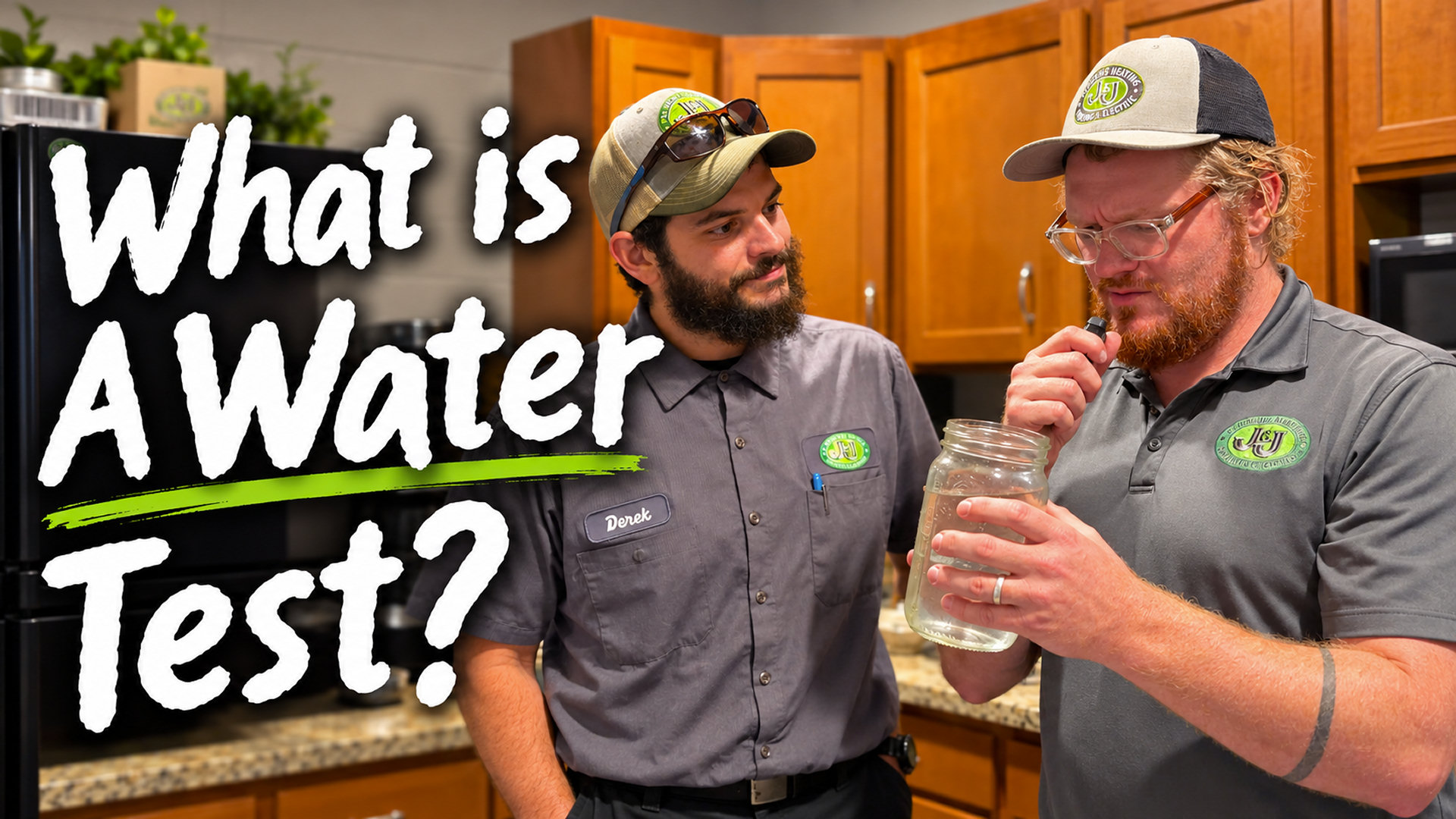
We asked Derek from the J&J plumbing team that exact question.
And his answer was simple.
A water test can help identify several important characteristics of your home's water, including its pH, chlorine, iron, and hardness levels.
These measurements can help explain common household frustrations, from mineral buildup around your faucets to water that doesn't taste quite right.
Here's what each one means for your home.
1. pH Levels: Is Your Water Acidic or Alkaline?
Remember learning about the pH scale in science class?
It turns out that number can tell you something useful about your home's water.
The pH scale measures how acidic or alkaline water is.
A pH of 7 is neutral. Below 7 is acidic, and above 7 is alkaline.
For drinking water, the Environmental Protection Agency (EPA) recommends a secondary pH range of 6.5 to 8.5.
Why does that matter?
Water with a low pH can contribute to corrosion in certain plumbing systems, while water with a higher pH can contribute to deposits and other aesthetic issues.
And here's something important.
You can't reliably determine your water's pH just by looking at it.
That's why testing can be helpful.
A pH measurement doesn't tell you whether every possible contaminant is present, but it provides a useful piece of the bigger picture.
2. Chlorine: Why Does Your Water Sometimes Taste or Smell Different?
Have you ever filled a glass from the kitchen faucet and noticed a swimming-pool-like smell?
That can happen because many public water utilities use chlorine to disinfect drinking water.
And that's actually a good thing.
Chlorine helps protect drinking water from harmful microorganisms as it travels through the distribution system.
The CDC considers chlorine levels up to 4 parts per million safe in drinking water.
However, chlorine can also affect the taste and smell of your water.
For some families, that unpleasant taste is enough to make them reach for bottled water instead.
Here's the good news: You may not need to replace your entire home's water treatment system to address drinking water taste.
Depending on your test results and your family's goals, a properly selected drinking water filter might be an option.
And that could mean fewer trips to the store for cases of bottled water.
3. Iron: What's Causing Those Orange or Rust-Colored Stains?
Let's talk about a problem no homeowner enjoys.
You clean the bathroom sink.
A few days later, there's an orange or reddish-brown stain around the drain.
Or maybe you've noticed discoloration inside the toilet bowl, on laundry, or around plumbing fixtures.
One possible explanation is iron in your water.
Iron can enter drinking water naturally through groundwater or from iron-containing plumbing materials.
According to the EPA, the recommended secondary standard for iron in drinking water is 0.3 milligrams per liter, or approximately 0.3 parts per million.
Above that level, iron may contribute to:
- Reddish or brown staining on fixtures
- A metallic taste
- Discoloration of water
- Stains on laundry
These are primarily aesthetic and household-maintenance concerns, rather than proof that your water is unsafe.
And here's an interesting detail.
Some dissolved iron may be present in otherwise clear-looking water.
You may not notice it until it begins leaving stains.
Identifying iron can help homeowners understand whether specialized filtration or another treatment approach is worth considering.
4. Hard Water: Could Your Water Be Leaving Buildup Throughout Your Home?
Take a quick look at your showerhead.
Do you notice white, chalky deposits around the openings?
How about spots on your drinking glasses, soap scum in the bathtub, or crusty buildup around your kitchen faucet?
Those could be signs of hard water.
Hard water contains naturally occurring minerals, primarily calcium and magnesium.
These minerals aren't automatically harmful to drink.
But they can cause plenty of frustration around the house.
According to the U.S. Geological Survey (USGS), hard water can contribute to scale buildup inside water heaters, pipes, and other equipment.
That buildup can affect equipment performance and efficiency over time.
How Hard Is Your Water?
The USGS generally classifies water hardness this way:
| Hardness | Milligrams per liter |
|---|---|
| Soft | 0–60 |
| Moderately hard | 61–120 |
| Hard | 121–180 |
| Very hard | Above 180 |
These measurements are expressed as calcium carbonate.
The higher the hardness, the greater the potential for troublesome mineral deposits.
And here's the part many homeowners find surprising:
Even very hard water can look perfectly clear.
That's why a water hardness test can provide useful information you simply can't get from looking at your glass.
Do You Really Need a Whole-Home Water Treatment System?
Not necessarily!
That's one of the most important things we want Northeast Ohio homeowners to understand.
Your family's water treatment needs may be completely different from your neighbor's.
For example:
If your biggest complaint is drinking water taste: A properly selected drinking water filter or reverse osmosis system may make sense.
If your biggest frustration is mineral buildup: A water softener might be the better option.
If iron is causing staining: An iron-removal system or other suitable treatment may help, depending on the water chemistry.
If your water has unusual pH levels: Further evaluation can help determine whether corrective treatment is appropriate.
And if your water is already meeting your needs?
You may not need additional treatment at all.
The goal isn't to sell every homeowner the biggest system. It's to help you find the right solution for your home.
Why Water Quality Can Vary Across Northeast Ohio
Whether you live in Akron, Canton, Stow, Cuyahoga Falls, Tallmadge, Hudson, or a surrounding Northeast Ohio community, your water quality can depend on several factors.
Your home's water source matters.
Your plumbing materials matter.
And whether you receive municipal water or use a private well can make a difference.
That's why a water treatment system that makes sense for one household may be unnecessary for another.
If you're on municipal water, your utility's annual water-quality report is also a helpful source of information.
If your home uses a private well, regular testing is especially important.
Does a Basic Water Test Check for Everything?
No, and that's an important distinction.
A test that measures pH, chlorine, iron, and hardness gives you valuable information about those specific characteristics.
However, it does not automatically establish whether your water contains lead, PFAS, bacteria, pesticides, or other contaminants.
Those concerns may require additional laboratory testing using appropriate methods.
In other words, a basic water test is a useful first step—not a comprehensive safety certification.
At J&J, we want homeowners to understand what their results mean and when more testing may be appropriate.
Your Family Uses Water Every Day. Why Keep Guessing?
You don't have to be a water-quality expert.
You don't have to know the difference between reverse osmosis and carbon filtration.
And you shouldn't have to guess which expensive piece of equipment your home might need.
You simply need a starting point.
J&J Plumbing, Heating, Cooling & Electric can help you understand your home's water characteristics and explore treatment options with the support of our plumbing team.
Whether you're concerned about taste, scale, staining, or just curious about your home's water, getting answers is a smart place to begin.
💧 WA-TER You Waiting For?
Before you invest in water treatment, find out what your water actually needs.
Schedule your FREE Water Quality Test with J&J Plumbing, Heating, Cooling & Electric.
SCHEDULE MY FREE WATER QUALITY TEST →
J&J Plumbing, Heating, Cooling & Electric — Your Neighbors. Serving You.
Frequently Asked Questions
What does J&J's free water quality test check?
J&J's team explains that its basic water test checks characteristics such as pH, chlorine, iron, and water hardness. Contact J&J to confirm the exact tests included for your home.
Can my water look clean but still be hard?
Yes. Water hardness comes from dissolved calcium and magnesium, which aren't necessarily visible.
Is chlorine in drinking water unsafe?
Not automatically. Chlorine helps protect public drinking water from harmful microorganisms. The CDC considers levels up to 4 parts per million safe. However, chlorine can affect taste and odor.
What causes orange stains around faucets and sinks?
Iron is one possible cause. Testing can help determine whether iron is present and whether it may contribute to the staining.
Do I need a water softener and reverse osmosis system?
Not necessarily. A water softener addresses hardness, while reverse osmosis is generally used for drinking water treatment. Your needs depend on your water characteristics and goals.
Is the FREE Water Quality Test the same as a laboratory water analysis?
No. A basic screening test checks particular water characteristics. A comprehensive laboratory analysis may be needed for specific health-related contaminants.
Ready to learn more about your home's water?
Book Your FREE Water Quality Test Today →

We've had your back since 1989. For time-sensitive requests, please give us a call at 330-678-1400.